
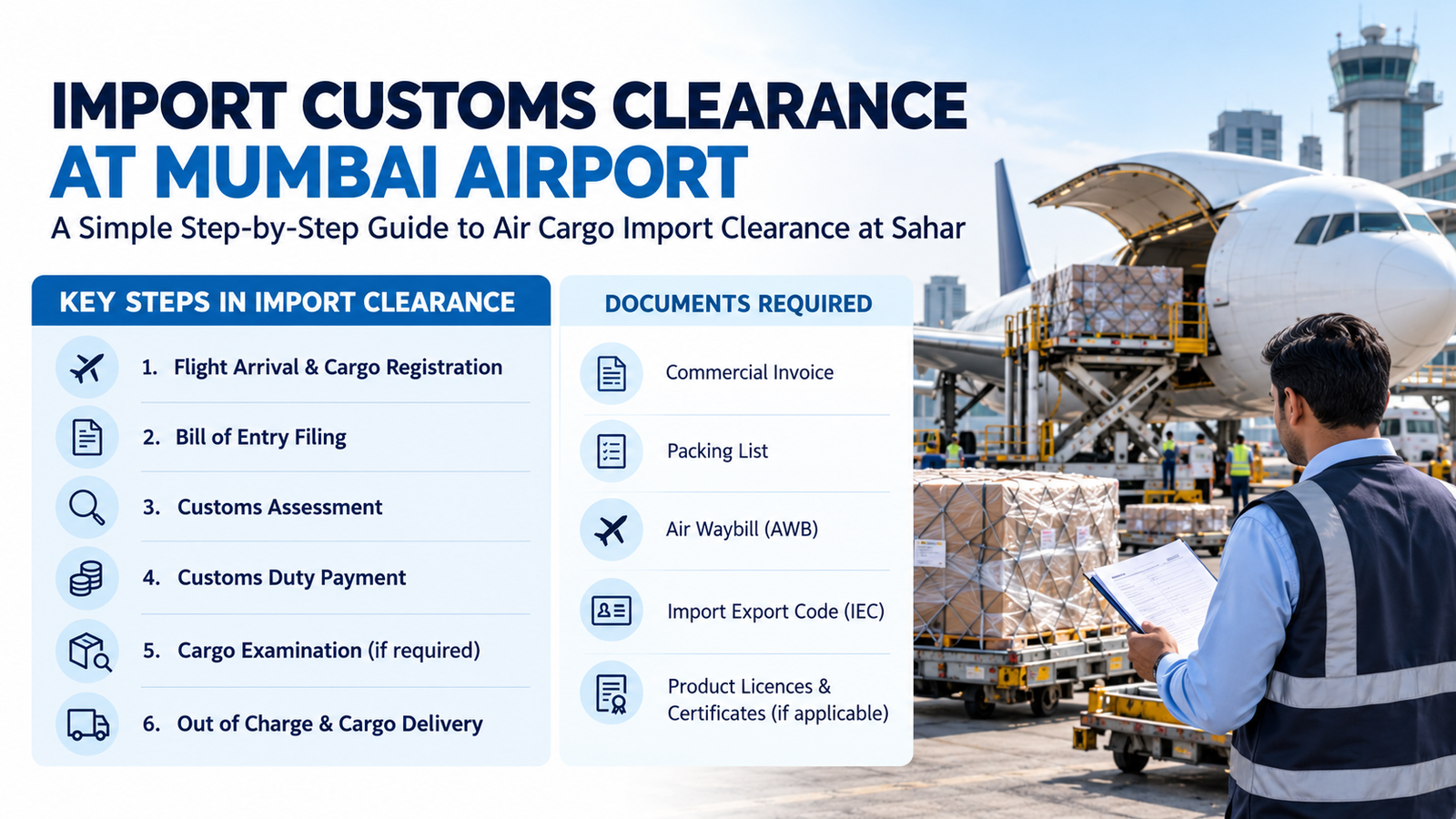
Your supplier has shipped the goods by air, the airline has sent an arrival notice, and now the cargo is sitting at the Mumbai Air Cargo Complex in Sahar. What happens next? For many importers, especially first-timers, this is where the confusion starts: which documents, which charges, who to call, and how long it will all take.
Our office is in Sahar Village, Andheri East, just a few minutes from the air cargo complex, and air cargo clearance is a big part of our day. This guide walks you through the import clearance process at Mumbai Airport in plain language, so you know what to expect and what to keep ready.
Why air cargo clearance in Mumbai needs planning
Air freight is chosen because it is fast. But the speed of the flight does not help much if the shipment then waits at the terminal because a document is missing or the invoice does not match the packing list. Storage charges at the airport start once the free period is over, and urgent cargo such as spare parts, samples or medicines cannot afford to sit idle.
The good news is that most delays at the air cargo complex are avoidable. They usually come down to three things: incomplete documents, incorrect product classification and late filing. Get those right and air cargo clearance in Mumbai is usually much smoother.
Documents needed for air cargo import clearance
Keep these ready, ideally before the flight lands:
- Commercial invoice: seller, buyer, product description, quantity, unit price, total value, currency and Incoterm.
- Packing list: number of packages, weights and the contents of each package.
- Air Waybill (AWB): the master AWB and, when a forwarder is involved, the house AWB.
- Importer Exporter Code (IEC): the IEC of the importer.
- Product literature or catalogue: useful for machinery, components and technical goods.
- Licences or certificates: BIS, FSSAI, drug, EPR or other approvals where applicable.
- Insurance and freight details: when these are not shown on the commercial invoice.
A tip from our desk: the invoice description should be clear and specific. “Spare parts” is not enough; “Bearing for printing machine, Model XYZ” is far more useful. Vague descriptions are a common reason Customs asks questions.
Step-by-step: import clearance at Mumbai Airport
Step 1: Flight arrival and cargo check-in
Once the flight lands, the airline files the import manifest and the cargo is moved into the import warehouse at the air cargo complex. The importer or forwarder receives an arrival notice containing the AWB details.
Step 2: Filing the Bill of Entry
Your customs broker files the Bill of Entry electronically through ICEGATE. This is the principal import declaration and records the goods, value, HS code and applicable duty. Supporting documents are uploaded online. Share the paperwork before arrival wherever possible so the filing can be prepared without delay.
Step 3: Assessment by Customs
The Customs system determines how the declaration will be handled. Some shipments are processed using the documents submitted, while others may be reviewed by an officer. Questions can relate to classification, value, description, origin or product compliance. Clear and prompt answers help keep the clearance moving.
Step 4: Paying customs duty
After assessment, the duty is calculated and paid online. Import duty can include Basic Customs Duty, Social Welfare Surcharge and IGST, plus product-specific duties where applicable. A preliminary duty estimate before arrival helps the importer plan funds.
Step 5: Cargo examination, if required
Some shipments are physically examined at the terminal. A Customs officer checks whether the goods, quantities, markings and packages match the declaration. Having a local team available at the air cargo complex helps coordinate this stage efficiently.
Step 6: Out of Charge and cargo delivery
After duty payment and any required examination, Customs issues the Out of Charge order. Terminal charges are paid, delivery documents are collected from the airline or its agent, and the cargo is released. Delivery from Sahar to Mumbai, Thane or Navi Mumbai can then be arranged according to the release time and traffic conditions.
How long does air cargo clearance take?
When documents are complete, the Bill of Entry is prepared in advance and no examination is required, many routine air shipments can be cleared within a day of arrival. Customs queries, missing approvals, valuation questions or physical examination can extend the timeline. No responsible broker should promise a guaranteed clearance time without reviewing the shipment.
The biggest factor is preparation. Sharing the invoice and packing list as soon as the supplier dispatches the goods gives everyone time to identify issues before the cargo lands.
Common delays at the air cargo complex
- Invoice and packing list do not match: verify quantities, package count and weights before dispatch.
- Incorrect or vague HS classification: review the product and classification basis before arrival.
- Missing licence or certificate: confirm whether BIS, FSSAI or another approval applies before ordering.
- Late filing: send documents early so the Bill of Entry can be prepared in advance.
- Slow replies to Customs: ensure someone familiar with the product can answer technical questions.
Air cargo clearance charges to budget for
The freight rate is only one part of the landed cost. Importers should also allow for:
- Customs duty and IGST based on the assessable value and HS classification.
- Airline or forwarder destination charges, including handling and delivery-order fees.
- Terminal handling and storage charges after the applicable free period.
- Customs broker charges for filing, assessment follow-up, examination and documentation.
- Local transport from Sahar to the importer’s office, factory or warehouse.
Eligible GST-registered businesses may be able to claim input tax credit for import IGST, subject to the applicable rules and records. Confirm the treatment with your accountant.
Checklist before your supplier ships
- Confirm that the importer name matches the IEC registration.
- Use clear descriptions, quantities, unit prices and total values for every item.
- Ensure the packing list matches the invoice package by package.
- Show the Incoterm and include freight and insurance details where relevant.
- Check whether any product licence or certificate is required.
- Share the documents with your customs broker and review the HS classification.
Why a customs broker near Mumbai Airport helps
Air cargo moves quickly, and the clearance response should be equally prompt. Our Sahar Village office is close to the Mumbai Air Cargo Complex, which helps our team attend examinations, coordinate documents and follow up at the terminal without losing hours travelling across the city.
Frequently asked questions
Can I clear air cargo myself at Mumbai Airport?
An importer may handle certain formalities, but most businesses use a licensed customs broker because electronic filing, assessment coordination and terminal procedures require experience and regular operational follow-up.
Who pays airport storage charges?
Terminal storage and handling charges are generally borne by the importer unless the commercial agreement states otherwise. Early document preparation can reduce avoidable storage.
What should I do when the shipment is urgent?
Inform your customs broker as soon as the booking is confirmed and share the invoice, packing list and AWB without waiting for arrival. Advance preparation gives the shipment the best chance of timely clearance.
Do you handle courier shipments at Sahar?
Yes. Courier and express shipments use a different terminal process. See our international courier and clearance service for details.
Have air cargo arriving at Mumbai Airport?
Send us the commercial invoice, packing list and AWB number. We will review what is required and explain the likely clearance and local-delivery charges.