
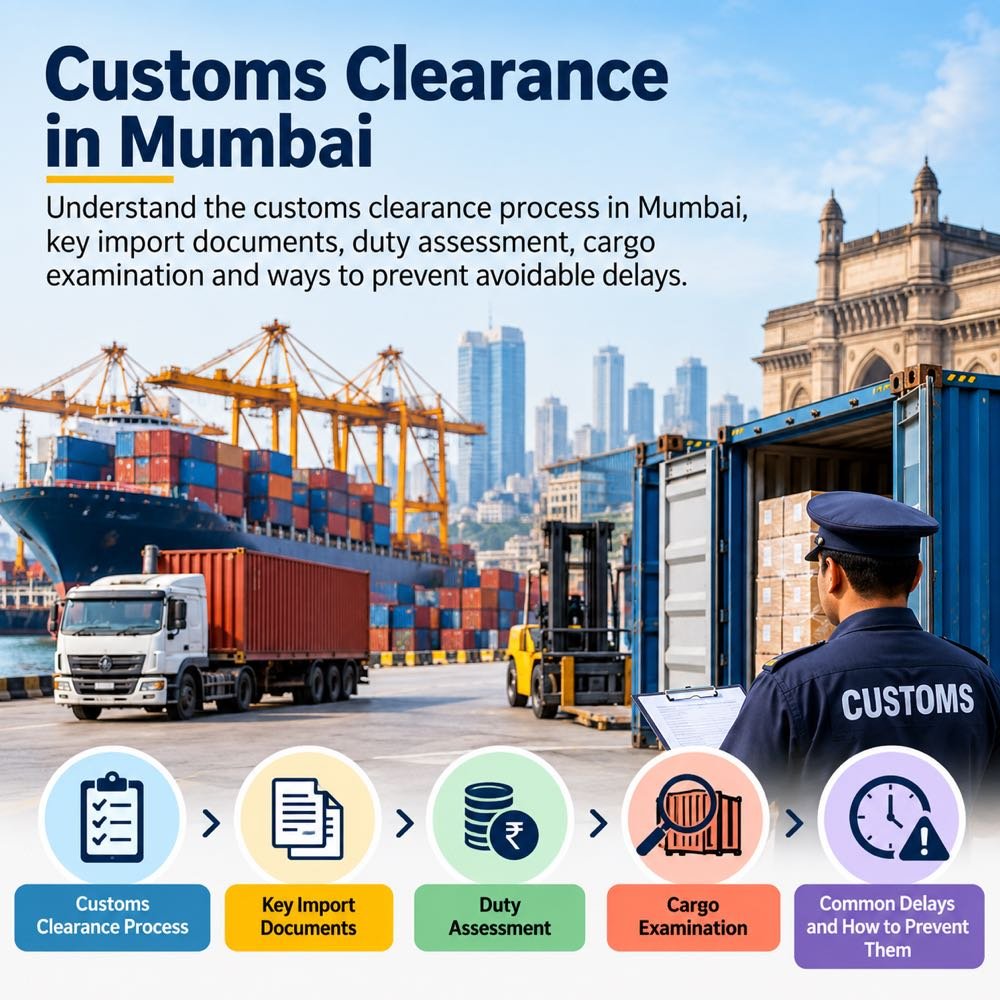
For an importer, customs clearance is the point where accurate documentation, correct classification and timely coordination come together. A small mismatch in the invoice, packing list or transport document can hold up an otherwise well-planned shipment. That is why businesses looking for customs clearance in Mumbai need a clear process before the cargo arrives.
This guide explains the usual import-clearance journey, the documents commonly requested, the reasons cargo may be examined and the practical steps that can reduce delay. Requirements vary by commodity, origin, mode of transport and current government instructions, so shipment-specific review remains essential.
What does customs clearance involve?
Customs clearance is the formal process used to declare imported goods, establish their classification and value, check whether any restrictions apply, assess duties and obtain release from Customs. The work begins before arrival, when commercial and transport documents are reviewed, and continues until the assessed obligations are completed and the cargo receives the required release.
A customs clearance agent coordinates the information supplied by the importer, carrier and other parties. The objective is not simply to file a declaration. It is to make sure the declaration is supported by consistent documents and that questions raised during assessment or examination are answered promptly.
Documents commonly required for import clearance
The exact document set depends on the product and transaction. Importers should normally prepare the following records early:
- Commercial invoice showing the seller, buyer, goods description, quantity, unit price, currency and agreed trade terms.
- Packing list showing package count, net and gross weight, dimensions and packing details.
- Bill of Lading for sea cargo or Air Waybill for air cargo.
- Importer Exporter Code (IEC) and applicable business or tax details.
- Purchase order, product catalogue or technical literature when required to support description, use or valuation.
- Country-of-origin document when a preferential duty claim or a product-specific requirement applies.
- Licence, registration, test report or no-objection document for regulated goods, where applicable.
- Insurance and freight details when these are needed for valuation.
Names, addresses, quantities, weights and product descriptions should match across the document set. If a document uses a general description such as “parts” or “samples,” obtain a precise commercial description before filing.
How the Bill of Entry fits into the process
For imports, the Bill of Entry is the core customs declaration. It records details such as the importer, supplier, transport document, tariff classification, assessable value, country of origin and the duty position claimed. Supporting documents should be ready before the declaration is filed so the information can be checked as one consistent set.
The importer remains responsible for the accuracy of the declared information. A pre-filing review is therefore valuable: confirm the product description, HS classification basis, valuation inputs, exemption claim if any, and the regulatory status of the goods.
Assessment, duty payment and cargo examination
After filing, the declaration may be processed according to Customs risk and assessment procedures. Customs may accept the declaration based on the available data, seek clarification, request additional records or select the cargo for examination. Duties and other assessed amounts must be handled through the prescribed process before release.
An examination does not automatically mean that something is wrong. It may be a routine risk-control step or a check of description, quantity, markings, classification or compliance. Clear package identification and quick access to product information help the examination team compare the physical cargo with the declaration.
Common reasons for customs-clearance delays
- Incomplete or inconsistent invoice and packing-list details.
- Incorrect or unsupported HS-code selection.
- Difference between declared and actual package count, weight or product description.
- Missing approval for restricted or regulated goods.
- Late receipt of the Bill of Lading, Air Waybill or arrival information.
- Questions about value, origin, end use or exemption eligibility.
- Slow responses when Customs asks for clarification or additional documents.
Most preventable delays begin before arrival. A document check carried out early gives the importer time to correct errors without losing valuable clearance time.
How to choose a customs clearance agent in Mumbai
Look for practical experience with your cargo type and mode of transport, a clear document checklist, defined communication points and transparent commercial terms. The agent should explain what information is missing, identify risks before filing and provide status updates that your procurement and finance teams can understand.
Ask who will handle the shipment, how queries will be escalated and which charges are included in the quotation. A reliable working process is more useful than a promise of an unrealistic clearance time.
Frequently asked questions
How long does customs clearance in Mumbai take?
There is no single guaranteed timeline. It depends on document readiness, cargo type, assessment, examination, regulatory approvals and the speed of responses to any query.
Can documents be reviewed before the shipment arrives?
Yes. Early review of the invoice, packing list, transport document, classification and product-specific approvals can reduce avoidable corrections after arrival.
Does every shipment undergo physical examination?
No. Examination depends on the applicable Customs process and risk selection. Importers should nevertheless keep cargo descriptions and package markings clear and consistent.