
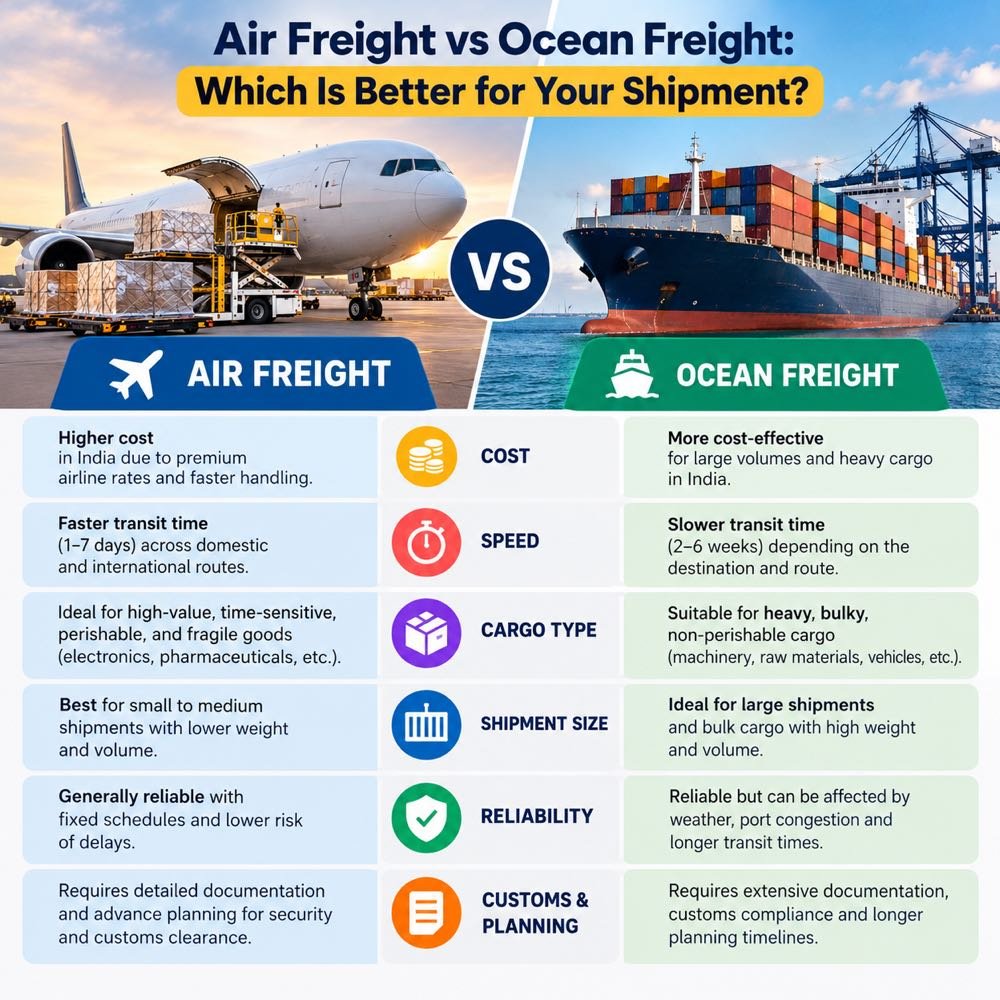
Choosing between air and ocean freight is not simply a choice between fast and cheap. The right mode depends on the commercial value of time, shipment size, product characteristics, delivery commitment and the total cost created by delay or excess inventory.
For businesses comparing air freight vs ocean freight in India, a structured decision can prevent both overpaying for speed and losing sales because a slow option was selected. This guide compares the two modes and explains what information to share when requesting a quotation.
Quick comparison
| Decision factor | Air freight | Ocean freight |
|---|---|---|
| Typical priority | Speed and schedule urgency | Economy and volume |
| Best suited to | Smaller, urgent or higher-value cargo | Larger or less time-sensitive cargo |
| Pricing basis | Chargeable weight and route | Container or volume-based factors and route |
| Transit profile | Generally shorter | Generally longer |
| Capacity sensitivity | Aircraft limits and booking availability | Sailing schedules, equipment and space |
| Document focus | Accurate description, dimensions, weight and air acceptance | Container/volume details, sailing documents and cargo acceptance |
Cost: compare the total landed impact
Ocean freight is often more economical for large, dense or non-urgent shipments, while air freight can be commercially sensible for small, valuable or time-critical consignments. A simple freight-rate comparison, however, may hide the real cost.
Consider inventory carrying cost, missed sales, production downtime, packaging, insurance, handling, customs-related charges and the financial impact of uncertainty. An urgent component moved by air may protect a production schedule; a regular replenishment order may be better planned by sea.
Speed and delivery commitments
Air freight generally offers shorter airport-to-airport transit, but the end-to-end plan must still include booking, cargo acceptance, flight connection, arrival handling and customs clearance. Ocean freight takes longer and is more exposed to sailing schedules, port rotation and container availability.
Use the required delivery date to work backward. If the business has a fixed launch, maintenance window or customer penalty, allow contingency instead of choosing a mode based only on an ideal transit estimate.
Cargo type and handling requirements
Product characteristics can narrow the choice. High-value electronics, samples, urgent spares and some temperature-sensitive goods may favour air. Machinery, bulkier commercial cargo and regular high-volume orders may favour sea.
Some goods are restricted or require special handling in either mode. Share the accurate commodity description, HS code if known, Safety Data Sheet where relevant, package dimensions, gross weight and special temperature or handling needs before accepting a quotation.
Shipment size: weight is not the only number
Air-freight pricing considers chargeable weight, which compares actual weight with volumetric weight. Large but light packages can therefore cost more than expected. For ocean freight, the choice may involve less-than-container-load or full-container arrangements, subject to route and operational suitability.
Provide dimensions for every package, not only the total weight. Accurate data allows the forwarder to compare modes and identify whether repacking or shipment consolidation could change the economics.
Customs planning applies to both modes
Air cargo is fast in transit, but incomplete documents can remove the speed advantage after arrival. Sea cargo also needs pre-arrival planning so the declaration, duty preparation and product-specific approvals do not begin only after the container reaches the port.
For either mode, keep the invoice, packing list and Bill of Lading or Air Waybill consistent. Review classification, valuation and import controls in advance. Customs clearance should be part of the routing decision, not an afterthought.
How to make the final decision
- Choose air when the financial value of speed is higher than the additional transport cost.
- Choose ocean when volume and unit economics matter more than the shortest transit time.
- Consider a planned mix when part of an order is urgent and the balance can move economically by sea.
- Compare quotations on the same scope, route, cargo data and assumptions.
- Build contingency for peak periods, connections, schedule changes and clearance requirements.
Frequently asked questions
Is air freight always more expensive than ocean freight?
Air freight often has a higher transport cost, but total business cost matters. For urgent, low-volume or high-value cargo, the faster option can reduce stock-out or downtime costs.
What details are needed for a freight quote?
Share origin, destination, commodity, package count, dimensions, gross weight, cargo readiness date, commercial value and any special handling or compliance needs.
Can one order use both air and ocean freight?
Yes. A split shipment can move urgent quantities by air and the balance by sea, subject to supplier, document and customs planning.